Cat Feeder RFID Guide: Microchip vs Collar-Tag Feeders
Affiliate linksWe earn a commission if you buy through our Amazon links, at no extra cost to you. It never changes what we recommend. How this works
The short answer
An RFID cat feeder opens its lid only for a pet it has registered. Some read the microchip already under your cat's skin, while others read only a tag on the collar. SureFeed, ePawDen and PawsPik feeders read implanted chips, while PETLIBRO's One RFID, HoneyGuardian's SF35 and Vancpet's feeder need a collar tag.
How does a microchip cat feeder work?
Sure Petcare's manual describes the design. Sensors in the hoop detect your cat's head, the reader checks its microchip or collar tag, and the lid opens. If an unregistered pet tries to eat, the lid stays shut, or closes if it was open.
Feeders that do this come in two kinds. A selective feeder guards a bowl that you fill by hand. A hybrid also dispenses scheduled meals, and opens only for its paired pet.
See feeders that open only for registered cats (7 feeders)
Selective or hybrid: which do you need?
Pick a selective feeder for wet food. Sure Petcare's manual says the SureFeed Microchip Pet Feeder has no timer, and ePawDen says its current feeder has no automatic feeding. Both brands say their bowls take wet and dry food.
Pick a hybrid for timed kibble meals. PETLIBRO's One RFID and the PawsPik Microchip Pet Feeder each schedule up to 10 meals a day. Both say dry food only, and each feeder pairs with one pet.
| Feeder and price | Recognises your cat by | Microchip standard | Food | Power | App |
|---|---|---|---|---|---|
| SureFeed Microchip Pet Feeder $169.99amazon.com price as of Oct 15, 10:26 PM UTCAmazon | Implanted microchip or Collar tag | All ID microchips, the brand says | Dry, Wet | Batteries only | App with the brand's hub |
| ePawDen Microchip Pet Feeder $135.99amazon.com price as of Oct 15, 10:26 PM UTCAmazon | Implanted microchip or Collar tag | 15-digit ISO (FDX-B) only | Dry, Wet, Raw | Rechargeable battery | No app needed |
| PawsPik Microchip Pet Feeder $249.99amazon.com price as of Oct 15, 10:26 PM UTCAmazon | Implanted microchip or Collar tag | 15-digit ISO (FDX-B) only | Dry | Mains with battery backup | Wi-Fi app |
| PETLIBRO One RFID Pet Feeder $139.99amazon.com price as of Oct 15, 10:26 PM UTCAmazon | Collar tag | Doesn't read implanted chips | Dry | Mains with battery backup | Wi-Fi app (2.4 and 5 GHz) |
| HoneyGuardian RFID Smart Feeder $123.49amazon.com price as of Oct 15, 10:26 PM UTCAmazon | Collar tag | Not stated by the brand | Dry | Mains with battery backup | Wi-Fi app |
| Vancpet RFID Cat Feeder $129.99amazon.com price as of Oct 15, 10:26 PM UTCAmazon | Collar tag | Doesn't read implanted chips | Dry, Wet | Not stated by the brand | Not stated by the brand |
| PapaPaw DietMatch $309.00amazon.com price as of Oct 15, 10:26 PM UTCAmazon | Face recognition | Not stated by the brand | Dry, Wet, Raw | Mains only | Wi-Fi app |
Will a feeder read my cat's microchip?
It depends on your cat's chip standard. The World Small Animal Veterinary Association (WSAVA) says a true ISO chip carries a 15-digit numeric code. It uses FDX-B technology at 134.2 kHz.
England made microchips compulsory for pet cats on 10 June 2024. Cats must be chipped before 20 weeks old, or owners risk a fine of up to £500. The regulations require ISO chips that respond to a 134.2 kHz FDX-B reader.
Ohio State's veterinary college notes the US has no national chip standard. It lists 125 kHz and 128 kHz chips in use beside 134.2 kHz ISO chips. WSAVA describes US HomeAgain chips as 10-character FDX-A codes read at 125 kHz.
Brands split on what their feeders read:
- Sure Petcare says the SureFeed works with all identification microchips worldwide.
- ePawDen reads 15-digit ISO FDX-B chips only. It says 9- and 10-digit chips are not supported.
- PawsPik reads ISO FDX-B chips only, and its returns policy excludes incompatible chips.
Find the chip number in your vet records and count the characters. WSAVA's description means a 15-digit number points to an ISO chip, and a 10-character code with letters does not.
Will it read your cat's microchip?
Chip types: The Ohio State University College of Veterinary Medicine, Indoor Pet Initiative; ePawDen (PAWDEN ROBOTICS LIMITED). Feeder support: each brand's own spec page, linked on the feeder's page.
No readable chip? SureFeed, ePawDen and PawsPik each come with a collar tag. Sure Petcare's manual says to use a safety collar with a breakaway buckle for the tag.
Which feeders work with a collar tag only?
PETLIBRO says the One RFID reads only its own collar tag, not microchips or other brands' tags. Vancpet says its RFID feeder works with the included collar tag, not implanted microchips. HoneyGuardian's SF35 also opens for its collar tag, with no mention of reading implanted chips.
PapaPaw's DietMatch takes a third route: the brand says it recognises each cat by face, so no chip or collar is needed. Unlike the tag hybrids, it takes wet food as well as dry.
Compare collar-tag feeders (6 feeders)
How long does training take?
Plan on at least a week, and longer for a nervous cat. Sure Petcare's manual sets out these steps:
Let your cat eat with the lid open
Use the feeder for a couple of days with no lid movement at all.Add lid movement in three stages
Each press of the training button closes the lid a little more. Sure Petcare suggests a few days for each stage.Move on only when your cat is relaxed
The manual says each stage can take days or weeks. A cautious pet can need several weeks.
Until the later stages, pets can eat from each other's feeders, the manual adds. Other brands offer gentler starts. PawsPik has an Open mode for cats that aren't food-motivated, and HoneyGuardian suggests starting with lid closing turned off.
Can one chip feeder keep two diets apart?
No. A selective feeder only keeps out pets that aren't registered on it. Every cat you register can open it, so it can't keep a diet cat's food from the others.
For a cat on a special diet in a multi-cat home, use two feeders. Register only the diet cat on one, with its diet food. Register the other cats on the second, so the diet cat can't eat their food.
Sure Petcare's manual recommends each pet has its own feeder for correct control of individual diets. Cats on the same food can still share a SureFeed, which stores up to 32 pets. PawsPik and PETLIBRO's One RFID pair with one pet each, so they mean one feeder per cat.
What are the limits?
- No guarantee: Sure Petcare says it can't fully guarantee every other pet is kept out. ePawDen says its current version can't completely stop other cats trying.
- Hard-to-read chips: ePawDen says pairing can fail because of chip format, implant position or nearby interference. Sure Petcare suggests the tag if a chip has moved.
- Power cuts: PawsPik keeps feeding on backup batteries, but chip and tag sensing switch off.
- No timer on selective bowls: Sure Petcare says not to rely on the SureFeed for more than 24 hours for a cat.
Feeding a stray? Read whether a microchip feeder works for a stray cat. If the food thief is a dog, see how to keep a dog out of cat food.
Which one fits your home?
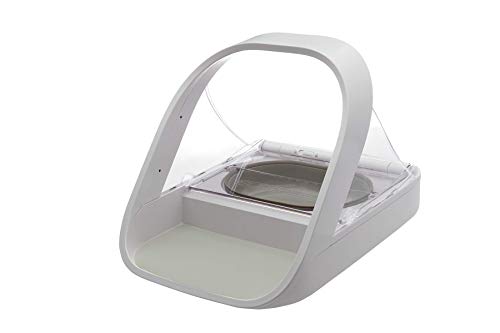
Why it fits: the broadest chip support of these feeders, wet or dry food, and up to 32 pets sharing one feeder.
- Recognises your cat by
- Implanted microchip or Collar tag
- Microchip standard
- All ID microchips, the brand says
- Pets it can register
- Up to 32, all able to open it
- Food
- Dry, Wet
- Capacity
- 0.4 L
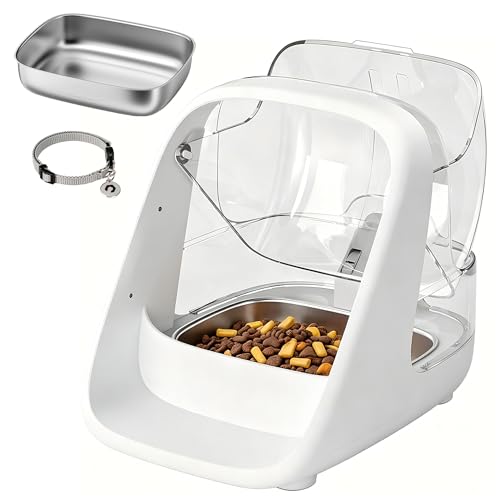
Why it fits: a rechargeable covered bowl for a cat with a 15-digit ISO chip.
- Recognises your cat by
- Implanted microchip or Collar tag
- Microchip standard
- 15-digit ISO (FDX-B) only
- Food
- Dry, Wet, Raw
- Capacity
- 0.5 L
- Power
- Rechargeable battery
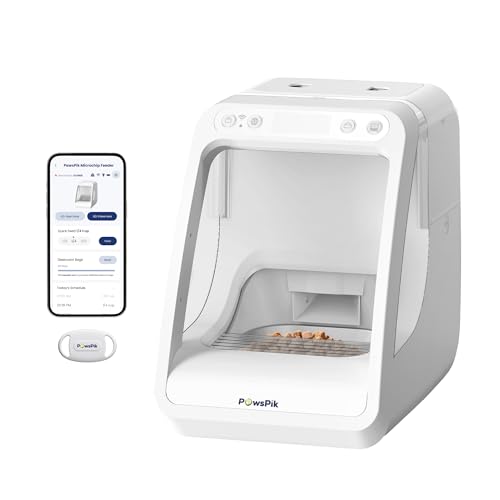
Why it fits: timed dry meals behind a door that opens for one cat's ISO chip or tag.
- Recognises your cat by
- Implanted microchip or Collar tag
- Microchip standard
- 15-digit ISO (FDX-B) only
- Food
- Dry
- Capacity
- 3.85 L
- Portion size
- About 10 g
For a rechargeable alternative to SureFeed, see the ePawDen Microchip Pet Feeder. Two head-to-heads cover the most common choices: SureFeed vs PETLIBRO One RFID and SureFeed vs ePawDen.
Questions owners ask
How does a microchip cat feeder work?
A microchip feeder keeps its bowl covered and opens the lid only when it reads the ID of a registered pet. Sure Petcare's manual explains that sensors in the hoop detect a pet's head, the reader then checks its implanted microchip or collar tag, and the lid opens for up to 32 stored pets. The lid closes after a short delay once the pet leaves and stays shut for unregistered animals. Sure Petcare's model has no timer; hybrids such as PawsPik's also dispense scheduled meals.
Sources: Sure Petcare; Sure Petcare; PawsPik
Are microchip cat feeders worth it?
They are worth it if one pet keeps eating another's food, especially a prescription or weight-loss diet. In a small 2022 study of 23 overweight cats in multi-cat homes, cats fed from a pet-separating automatic feeder were more likely to reach a healthy body condition, and owners found the plan easier. The limits are real: training can take days or weeks, some models read only certain chips, and Sure Petcare and ePawDen both say other pets can't be kept out in every case.
Sources: PubMed (U.S. National Library of Medicine); Sure Petcare; ePawDen (PAWDEN ROBOTICS LIMITED); PawsPik
Will a microchip feeder read my cat's microchip?
It depends on your cat's chip and the feeder. England's microchipping law, which has covered pet cats since June 2024, requires ISO-standard FDX-B chips read at 134.2 kHz, but in the US chips at 125 kHz and 128 kHz are also in use. ePawDen and PawsPik read only the ISO type. Sure Petcare says its feeder reads chip codes worldwide, yet its manual notes a chip that has moved may be hard to read. Check the chip number in your vet records.
Sources: legislation.gov.uk (UK Government); GOV.UK (Defra); The Ohio State University College of Veterinary Medicine, Indoor Pet Initiative; ePawDen (PAWDEN ROBOTICS LIMITED); PawsPik; Sure Petcare; Sure Petcare
Is there a selective feeder that works without a collar?
Yes, if your cat has a compatible implanted microchip. Sure Petcare says its SureFeed feeders work with all ID microchips, while ePawDen's and PawsPik's feeders read only ISO FDX-B chips, the 15-digit international standard. Collar-tag feeders such as PETLIBRO's One RFID and Vancpet's RFID feeder can't read implanted chips at all. Check your cat's chip number with your vet before buying, because PawsPik doesn't accept returns for incompatible chips.
Sources: Sure Petcare; ePawDen (PAWDEN ROBOTICS LIMITED); PawsPik; PETLIBRO; Vancpet
What's the difference between an RFID collar feeder and a microchip feeder?
Both use radio-frequency ID; the difference is where the ID sits. A microchip feeder reads the chip implanted under your cat's skin, and SureFeed, PawsPik and ePawDen also accept a collar tag. An RFID collar feeder reads only a tag worn on the collar, often the brand's own: PETLIBRO says its One RFID works only with its dedicated tag. The AAFP notes implanted chips can't be lost, and Sure Petcare advises a breakaway safety collar for cats using a tag.
Sources: GOV.UK (Defra); Sure Petcare; PawsPik; ePawDen (PAWDEN ROBOTICS LIMITED); PETLIBRO; American Association of Feline Practitioners (FelineVMA); Sure Petcare
Sources
- Microchip Pet Feeder User Manual, Sure Petcare
- SureFeed Microchip Pet Feeder, Sure Petcare
- ePawDen Microchip Pet Feeder, ePawDen (PAWDEN ROBOTICS LIMITED)
- FAQ, ePawDen (PAWDEN ROBOTICS LIMITED)
- Microchip Pet Feeder, PawsPik
- One RFID Pet Feeder, PETLIBRO
- RFID Smart Pet Feeder (SF35), HONEYGUARDIAN
- SF35 User Manual, HONEYGUARDIAN
- RFID Collar Cat Feeder for Multi-Cat Homes (VC009), Vancpet
- PapaPaw DietMatch Smart Automatic Cat Feeder, PapaPaw
- FAQ, PapaPaw
- Microchip FAQs, World Small Animal Veterinary Association (WSAVA)
- Cat microchipping now mandatory, GOV.UK (Department for Environment, Food & Rural Affairs)
- The Microchipping of Cats and Dogs (England) Regulations 2023, legislation.gov.uk (UK Government)
- Microchip Fact Sheet (Linda K. Lord, DVM, PhD), The Ohio State University College of Veterinary Medicine, Indoor Pet Initiative